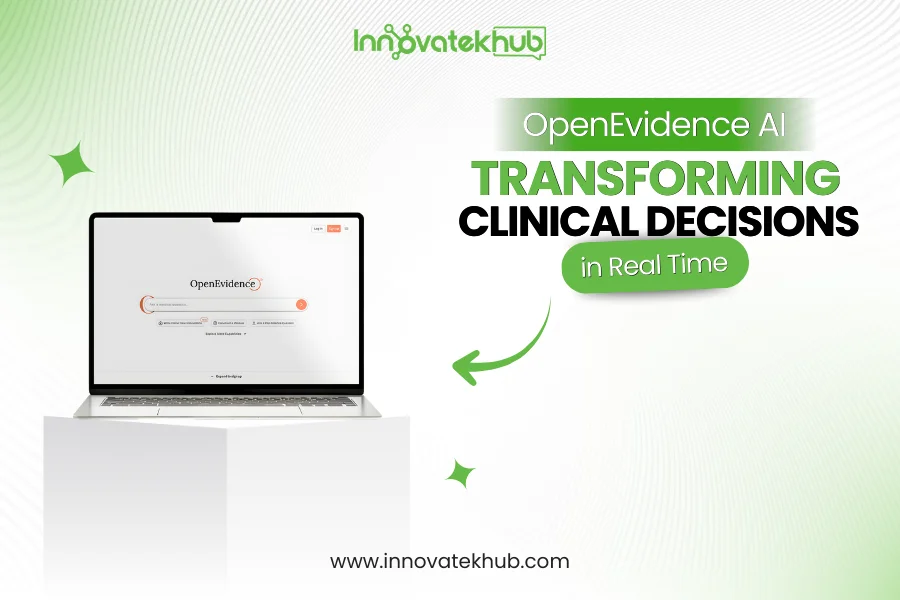
Healthcare is evolving fast. Doctors today are not just healers; they are decision-makers navigating complex medical data, evolving guidelines, and time-sensitive patient needs. In this high-pressure environment, access to reliable, real-time medical knowledge can make a life-saving difference. This is where OpenEvidence AI steps in.
At Innovatek Hub, we explore technologies that genuinely reshape industries. OpenEvidence AI is one of those tools that is quietly transforming modern healthcare by bringing evidence-based medicine directly into clinical workflows.
Let’s explore what OpenEvidence AI is, how it works, its benefits, limitations, and why it is becoming a serious asset in medical practice.
What Is OpenEvidence AI
OpenEvidence AI is an artificial intelligence-powered clinical decision support platform designed to help healthcare professionals access peer-reviewed medical evidence instantly. Instead of manually searching through journals, guidelines, and research databases, physicians can ask direct clinical questions and receive referenced, evidence-backed answers in seconds.
Unlike generic AI chatbots, OpenEvidence AI focuses specifically on medical knowledge retrieval, evidence synthesis, and clinical reasoning support.
Its core objective is simple:
Deliver accurate, up-to-date medical evidence at the point of care.
Why Evidence-Based Medicine Needs AI
Evidence-based medicine (EBM) has always been the gold standard in healthcare. However, the challenge is not lack of information, it is information overload.
Every year:
- Thousands of medical research papers are published.
- Clinical guidelines are updated.
- Drug safety alerts are revised.
- Treatment protocols evolve.
For a busy clinician, staying fully updated is almost impossible without assistance. Traditional research tools like:
- PubMed
- National Institutes of Health
- World Health Organization
provide access to research, but they require time, filtering skills, and careful interpretation.
OpenEvidence AI bridges this gap by converting massive medical datasets into concise, clinically relevant insights.
How OpenEvidence AI Works
OpenEvidence AI combines several advanced technologies:
1. Natural Language Processing
Doctors can type questions in plain language such as:
- What is the first line treatment for hypertension in elderly patients?
- Is drug X safe during pregnancy?
- What are updated sepsis management guidelines?
The AI understands clinical language and medical terminology.
2. Evidence Retrieval System
The platform pulls data from peer-reviewed journals, medical research databases, and clinical guidelines.
3. Citation Based Responses
One of the strongest features is that answers include citations from credible sources. This reduces hallucination risk and increases trust among healthcare professionals.
4. Continuous Updating
Medical knowledge changes rapidly. OpenEvidence AI is designed to incorporate new research so clinicians receive updated recommendations.
Key Features of OpenEvidence AI
Real Time Clinical Answers
Doctors get rapid responses during consultations without leaving their workflow.
Referenced Medical Evidence
Each answer is supported by citations, increasing transparency and reliability.
Structured Summaries
Instead of reading long research papers, users receive summarized insights.
Drug Interaction Insights
The system can assist in checking contraindications and safety considerations.
Clinical Guidelines Access
Updated recommendations from recognized institutions are integrated.
Benefits of OpenEvidence AI in Healthcare
1. Faster Clinical Decision Making
Time is critical in healthcare settings such as emergency departments and intensive care units. Quick access to accurate medical information improves patient care.
2. Improved Diagnostic Support
AI does not replace doctors, but it strengthens their clinical reasoning by presenting supporting evidence.
3. Reduced Medical Errors
Evidence-backed responses reduce the likelihood of outdated or incorrect treatments.
4. Support for Young Doctors and Medical Students
For interns and residents, OpenEvidence AI works like a knowledge companion, guiding them toward trusted medical literature.
5. Workflow Efficiency
Instead of switching between multiple research platforms, clinicians get consolidated answers in one place.
There is a major difference between OpenEvidence AI and general AI platforms.
| Feature |
OpenEvidence AI |
General AI Chatbots |
| Focus |
Medical evidence |
Broad topics |
| Citations |
Yes |
Not always |
| Clinical guidelines |
Integrated |
Limited |
| Risk of hallucination |
Lower |
Higher |
| Designed for healthcare |
Yes |
No |
Healthcare demands precision. A small mistake in interpretation can have serious consequences. That is why domain-specific AI systems like OpenEvidence AI are becoming more trusted.
Ethical and Regulatory Considerations
AI in healthcare raises important questions:
- Who is responsible if AI advice is incorrect?
- How is patient data protected?
- Is the system compliant with medical regulations?
OpenEvidence AI is designed as a decision support tool, not a replacement for clinical judgment. The final responsibility always remains with the healthcare professional.
Privacy and compliance are critical, especially under regulations like HIPAA in the United States and GDPR in Europe.
Limitations of OpenEvidence AI
No technology is perfect. OpenEvidence AI also has limitations.
Dependency Risk
Over-reliance on AI can reduce independent clinical reasoning if not used responsibly.
Data Coverage Boundaries
If certain emerging studies are not yet indexed, they may not appear in responses.
Internet Requirement
Real-time access requires stable connectivity.
Interpretation Still Required
Even evidence-based answers need human interpretation in context of individual patients.
Role in Modern Healthcare Ecosystem
OpenEvidence AI represents a broader shift toward AI-powered healthcare systems. Across the industry, artificial intelligence is being used in:
- Radiology image analysis
- Predictive analytics
- Electronic health record optimization
- Personalized treatment planning
Major health technology players such as:
- IBM Watson Health
- Google Health
have explored AI-driven medical solutions. However, OpenEvidence AI’s niche focus on evidence retrieval gives it a unique position.
Impact on Medical Education
Medical students traditionally spend years mastering textbook knowledge. But textbooks become outdated quickly.
With OpenEvidence AI:
- Students can cross-check concepts.
- Residents can validate treatment plans.
- Researchers can explore referenced studies faster.
This shifts medical education toward a more dynamic, continuously updated learning model.
The Future of OpenEvidence AI
The future likely includes:
Integration with Electronic Health Records
Direct embedding inside hospital systems to provide contextual recommendations.
Personalized Evidence Filtering
AI tailors evidence based on patient demographics.
Global Expansion
Localization for different healthcare systems worldwide.
Multilingual Support
Helping non-English speaking healthcare providers access research efficiently.
As artificial intelligence continues to mature, clinical support systems will become more sophisticated, accurate, and context-aware.
Should Healthcare Professionals Use OpenEvidence AI
The answer depends on how it is used.
When treated as:
- A supportive knowledge tool
- A time-saving research assistant
- A verification system for clinical decisions
OpenEvidence AI can significantly enhance medical practice.
But it should never replace professional expertise, clinical experience, or patient-centered judgment.
Final Thoughts from Innovatek Hub
At Innovatek Hub, we believe technology should empower professionals, not replace them. OpenEvidence AI reflects that philosophy. It does not aim to become a doctor. Instead, it becomes the silent assistant working in the background, scanning journals, summarizing research, and presenting credible evidence in seconds.
In a world where medical knowledge doubles rapidly, tools like OpenEvidence AI help bridge the gap between research and real-world practice. Healthcare is not just about treatment. It is about informed decisions, responsible action, and continuous learning. OpenEvidence AI supports all three.
As artificial intelligence reshapes industries globally, healthcare remains one of the most impactful areas of transformation. And platforms like OpenEvidence AI are at the heart of this evolution.













No Comments