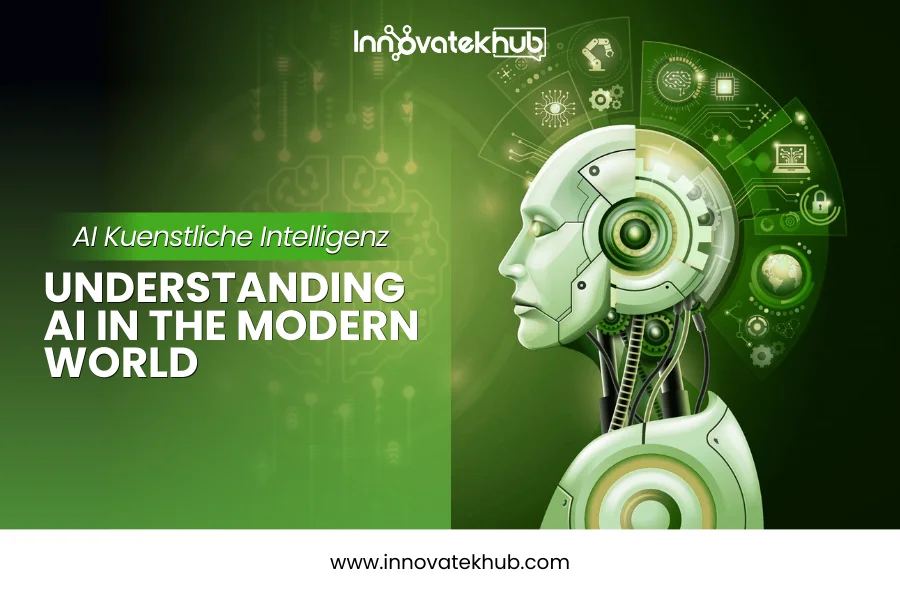
Artificial intelligence, known in German as AI Kuenstliche Intelligenz, is no longer a futuristic concept. It has become a central force shaping industries, economies, and everyday life. From smart assistants in our phones to advanced automation in factories, artificial intelligence is redefining how humans interact with technology.
At Innovatek Hub, we focus on emerging technologies that influence global transformation. In this detailed guide, we explore what AI Kuenstliche Intelligenz truly means, how it works, its types, applications, advantages, risks, and the future of AI innovation in a rapidly evolving digital world.
What Is AI Kuenstliche Intelligenz
AI Kuenstliche Intelligenz translates to artificial intelligence in English. It refers to computer systems designed to simulate human intelligence processes such as:
- Learning
- Reasoning
- Problem-solving
- Decision-making
- Language understanding
- Visual recognition
Unlike traditional software that follows fixed instructions, AI systems learn from data and improve over time. They identify patterns, analyze trends, and generate predictions without being explicitly programmed for every task.
Artificial intelligence combines computer science, mathematics, statistics, neuroscience, and data engineering to create systems capable of intelligent behavior.
The Evolution of Artificial Intelligence
The concept of artificial intelligence began in the mid-20th century. Early researchers aimed to create machines capable of thinking like humans.
In 1956, the term artificial intelligence was formally introduced at the Dartmouth Conference. Over decades, AI progressed through multiple phases:
- Rule-based systems
- Machine learning models
- Deep learning networks
- Generative AI technologies
Organizations such as OpenAI and Google AI have significantly accelerated AI innovation in recent years.
Today, AI Kuenstliche Intelligenz powers everything from recommendation algorithms to advanced robotics.
Types of Artificial Intelligence
Artificial intelligence can be categorized into several types based on capability and functionality.
1. Narrow AI
Also known as weak AI, this type is designed for specific tasks. Examples include:
- Voice assistants
- Facial recognition systems
- Spam filters
- Recommendation engines
Most AI systems in use today fall under this category.
2. General AI
General AI refers to systems that can perform any intellectual task that a human can do. This level has not yet been achieved but remains a long-term research goal.
3. Superintelligent AI
This hypothetical form of AI would surpass human intelligence in all aspects. While still theoretical, it raises significant ethical and governance questions.
Core Technologies Behind AI Kuenstliche Intelligenz
Artificial intelligence operates through several technical foundations.
Machine Learning
Machine learning allows systems to learn from data rather than being manually programmed. Algorithms detect patterns and make predictions based on historical data.
Deep Learning
Deep learning uses neural networks inspired by the human brain. These models are particularly powerful for:
- Image recognition
- Speech processing
- Natural language understanding
Natural Language Processing
NLP enables machines to understand and generate human language. It powers chatbots, translation tools, and content generation systems.
Computer Vision
Computer vision allows machines to interpret visual data from images and videos.
Applications of AI Kuenstliche Intelligenz Across Industries
Artificial intelligence is transforming nearly every sector.
Healthcare
AI assists doctors with:
- Medical image analysis
- Disease prediction
- Drug discovery
- Personalized treatment planning
Hospitals use AI-powered systems to improve diagnostics and patient care efficiency.
Finance
Banks and financial institutions rely on AI for:
- Fraud detection
- Risk assessment
- Algorithmic trading
- Credit scoring
Automated financial systems increase speed and reduce human error.
Automotive Industry
Companies like Tesla integrate AI into autonomous driving systems. These vehicles use sensors, cameras, and AI models to navigate roads.
E Commerce
Online platforms use AI recommendation systems to personalize shopping experiences. AI analyzes user behavior to suggest products and improve customer engagement.
Education
AI-powered learning platforms adapt lessons according to student performance, offering personalized education paths.
Manufacturing
Smart factories use AI-driven robotics and predictive maintenance systems to enhance production efficiency.
AI in Germany and Europe
The term AI Kuenstliche Intelligenz reflects Germany’s growing interest in artificial intelligence development.
Germany has invested heavily in AI research and innovation, with universities and research centers advancing machine learning and robotics technologies.
The European Union has also introduced the AI Act to regulate high-risk AI systems and ensure ethical deployment.
Europe aims to balance technological progress with strong data protection and ethical standards.
Advantages of AI Kuenstliche Intelligenz
Artificial intelligence offers numerous benefits.
Increased Efficiency
AI automates repetitive tasks, saving time and reducing operational costs.
Data Driven Decision Making
Organizations can analyze vast amounts of data quickly and accurately.
Enhanced Customer Experience
AI-powered chatbots and recommendation systems improve user interaction.
Innovation Acceleration
AI speeds up research in medicine, engineering, and environmental science.
Error Reduction
Automation reduces human errors in high-precision tasks.
Challenges and Risks of Artificial Intelligence
Despite its advantages, AI Kuenstliche Intelligenz presents serious challenges.
Job Displacement
Automation may replace certain roles, especially repetitive manual jobs.
Data Privacy Concerns
AI systems require large datasets, raising questions about personal data protection.
Algorithmic Bias
If training data contains bias, AI systems may produce unfair results.
Lack of Transparency
Some AI models operate as black boxes, making decision processes difficult to explain.
Security Threats
AI can be misused for cyberattacks, deepfakes, and misinformation.
Responsible development and regulation are essential to mitigate these risks.
AI Governance and Ethical Frameworks
To ensure responsible AI deployment, governance frameworks are being developed globally.
Organizations like United Nations emphasize ethical AI principles such as:
- Transparency
- Fairness
- Accountability
- Privacy protection
- Human oversight
Ethical AI development ensures that technology benefits society while minimizing harm.
The Role of Generative AI
Generative AI represents one of the fastest-growing segments of artificial intelligence. Systems developed by companies such as OpenAI can generate text, images, and even code.
Generative AI applications include:
- Content creation
- Marketing automation
- Virtual assistance
- Creative design
While powerful, generative AI also raises concerns about misinformation and intellectual property.
AI and the Future of Work
Artificial intelligence will not eliminate all jobs. Instead, it will transform work environments.
Future job trends include:
- AI specialists and data scientists
- Robotics engineers
- AI ethics officers
- Automation managers
Workers who develop digital skills will benefit from AI-driven industries.
Continuous learning and adaptation will be key in the AI-powered economy.
Human and Machine Collaboration
The most realistic future is not AI replacing humans, but AI collaborating with humans.
Examples include:
- Doctors using AI diagnostic support
- Lawyers analyzing legal documents with AI tools
- Marketers using predictive analytics
- Engineers optimizing designs with AI simulation
Human creativity combined with machine precision creates powerful synergy.
The Future of AI Kuenstliche Intelligenz
Artificial intelligence is expected to evolve in several directions:
- Advanced robotics integration
- Smarter autonomous systems
- Enhanced emotional intelligence simulation
- Sustainable AI models with lower energy consumption
- Global regulatory alignment
As computing power increases and algorithms improve, AI systems will become more sophisticated and context-aware.
However, ethical responsibility must grow alongside innovation.
Final Thoughts from Innovatek Hub
AI Kuenstliche Intelligenz represents one of the most transformative technologies of the 21st century. It influences healthcare, finance, education, manufacturing, transportation, and digital communication.
At Innovatek Hub, we believe that understanding artificial intelligence is essential for individuals and businesses alike. AI is not just a technical advancement. It is a social, economic, and ethical revolution.
The future will belong to those who learn how to work alongside intelligent systems responsibly. With balanced governance, ethical development, and continuous innovation, AI Kuenstliche Intelligenz has the potential to unlock extraordinary progress for humanity.
The journey of artificial intelligence is still unfolding. And its impact on the world is only beginning.







No Comments